
New

EUR
219,00 Excl. VAT
*
EUR
260,61 VAT included
*
In Stock


Knee pads and knee protectors for tilers are not just simple accessories but an indispensable part of the basic equipment in the trade. Anyone who lays tiles every day works many hours on their knees – on hard concrete, rough screed or cold tiles. Without protection, this strain quickly leads to pain, inflammation and long-term joint damage. Effective knee protection is therefore not only sensible but absolutely necessary to maintain health and ensure performance. But every knee is different. Body shape, weight, movement patterns and medical history all play a major role. A knee pad that fits perfectly for one colleague may pinch, slip or provide insufficient padding for another tradesperson. That’s why it’s important to choose a model that meets your individual requirements. Only then will your knees be permanently protected and working on your knees remain possible for many years to come.
Working on your knees strains joints, muscles and ligaments equally. Those who work without protection soon feel the first discomfort. Over the years, serious problems can develop – from irritated bursae to cartilage wear and even osteoarthritis. Knee pads and knee protectors for tilers prevent this damage by evenly distributing pressure, cushioning impacts and avoiding contact with cold or rough surfaces. An example of a comfortable entry-level model is the Professional Knee Pad with Gel Insert (Art.-No. 12063). It is equipped with multi-layer padding and a gel insert that provide high comfort even during many hours of kneeling. A robust TPR plastic front cap provides stability and prevents slipping. Wide hook-and-loop fasteners secure the pads reliably without cutting in or slipping. This knee pad is therefore an ideal basic piece of equipment for tilers who value comfort and durability.
Every knee is unique. Some tradespeople have narrower knees, others wider. Some are lighter, others put more weight on the joints. The way you work is also crucial: those who move around a lot need different features than someone who works long in one position. For tradespeople with existing knee problems such as meniscus or cartilage damage, even pressure distribution is particularly important. For these requirements, the Gelmaster Knee Pad (Art.-No. 10247) is the right choice. Its large, soft gel padding adapts flexibly and provides unparalleled pressure relief. Many users describe the wearing experience as “kneeling like in butter.” Even sensitive knees remain pain-free after long working days. The Gelmaster is also certified to DIN EN 14404 and thus meets the highest safety standards.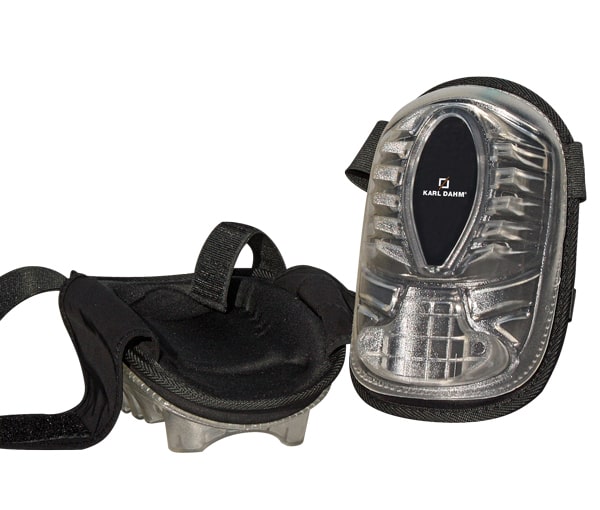
In addition to classic knee pads, there are also models that cover more than just the knees. A good example is the Knee and Shin Guards (Art.-No. 12034). These extra-long guards protect not only the knee but also the shin. This is particularly helpful when working for long periods on hard floors where the strain affects not just the knees but also the lower legs. The inside is breathable so that the legs remain pleasantly cool even during long use. At the same time, the outer surface is waterproof, so moisture and dirt have no chance. Another model with a special focus on ergonomics is the Ergonomic Knee Protector (Art.-No. 10207). Its special design relieves targeted pressure on the kneecap and additionally stabilizes the joints. Thanks to the funnel-shaped construction, the kneecap is protected while the load is evenly distributed over the shin. Wide, adjustable straps ensure high wearing comfort. This model is also certified to DIN EN 14404 and thus meets all requirements for tested knee protection.
Not everyone immediately needs a high-tech gel model. For occasional work or beginners, the Standard Knee Pad (Art.-No. 10184). is suitable. It is easy to handle, yet offers certified protection according to DIN EN 14404 and is particularly attractively priced. This makes it a good choice for anyone looking for solid basic protection. An interesting alternative is the Knee Cushion (Art.-No. 12192). Unlike classic knee pads, these are not fastened to the leg but simply placed underneath. A rubber mat on the underside reliably protects the knee and ankle joints from moisture and cold. These cushions are particularly practical for short tasks and can be used flexibly without having to be worn on the leg. For tilers who need to move around a lot, the Knee Pad with Joint (Art.-No. 10212) offers an ideal solution. Thanks to the joint mechanism, it is very movement-friendly without losing protection. The hard outer shell is moisture- and dirt-repellent, while the inner padding made of closed-cell foam provides comfort. This knee pad is also certified according to DIN EN 14404.
Knee pads differ not only in shape and size but also in the materials used. Gel pads provide soft, conforming cushioning and are ideal for long periods of kneeling. Foam pads are lighter and more versatile, while cellular rubber is particularly robust and durable. Construction also matters: soft models allow a lot of freedom of movement, while hard shells offer additional protection against sharp objects and rough surfaces.
In professional trades, not only comfort but also safety is important. The DIN EN 14404 standard precisely defines the requirements knee pads must meet. These include tested pressure distribution, impact absorption and slip resistance. All knee pads and knee protectors for tilers in the Karl Dahm range comply with this standard and thus offer reliable protection in everyday work.
For knee pads to provide full protection, they must be worn correctly. They should always sit centrally on the kneecap and be regularly checked for a secure fit. After each use, it’s advisable to clean the knee pads so that dirt and dust don’t damage the materials. Anyone who kneels daily should replace their knee pads after one to two years, as even high-quality materials lose cushioning over time.
Tilers spend hours kneeling on hard, uneven or wet surfaces, exposing their knees to strong pressure and shear forces. Standard knee pads are usually uniformly shaped and cannot distribute these loads effectively. Ergonomic, well-fitted knee pads adapt to the natural shape of the knee, prevent slipping and protect joints, cartilage, and ligaments from long-term damage. They also increase comfort and work efficiency throughout the day.
A good knee pad for tilers should be ergonomic, offer equal pressure distribution and allow unrestricted movement. Gel or EVA foam inserts cushion impacts, while robust outer shells prevent abrasion on tiles or screed. Adjustable straps ensure a firm and comfortable fit. Certifications like EN 14404 guarantee safety standards. As every knee is different, testing various models is the best way to find perfect fit, stability, and comfort.
Hard shell knee pads protect against sharp edges, debris and uneven surfaces and prevent sinking into joints or gravel. Soft gel or foam knee pads provide superior comfort, adapt to the knee, relieve pressure and allow greater mobility. Many professionals switch between both types depending on the job site to ensure both protection and comfort.
Constant pressure, dirt and friction wear down padding, stitching and straps. Once the padding becomes flat, straps no longer hold or cracks appear, replacement is necessary. Regular cleaning, drying and storing in a dry, shaded place can significantly extend their lifespan.
Especially products like the knee pad (Art. No. 12192) offer excellent protection against wet and cold surfaces. Waterproof materials and insulating layers keep knees warm and dry, even on damp concrete or outdoors. This prevents irritation, joint inflammation and makes working more comfortable.
Knee protection benefits not only tilers but also floor layers, drywall installers, painters, roofers, plumbers, garden workers and more. They prevent pressure points, bruises, joint irritation and protect against cold ground. In any trade involving hard, rough or damp surfaces, knee pads significantly improve health and work performance.
Without knee protection, constant pressure can lead to cartilage wear, bursitis, chronic pain and even occupational diseases. Knee pads distribute weight, absorb impacts and reduce friction with the ground. They improve health, endurance and efficiency throughout the workday.
Certified knee pads meeting DIN EN 14404 standards ensure tested protection and ergonomic design. Shock-absorbing gel or foam, abrasion-resistant shells, non-slip surfaces and breathable fabrics are key quality indicators. Adjustable wide straps ensure comfort and a secure fit. Trusted brands with positive reviews offer extra reliability.
On polished stone, parquet or glazed tiles, knee pads with soft, smooth or rubberized outer layers prevent scratches and pressure marks. They offer grip while being gentle on surfaces – ideal for interior installation and renovation work.
Dirt, mortar and adhesive residues damage materials over time. Cleaning with a damp cloth or mild soap after each workday is recommended. Velcro straps and elastic bands should be inspected regularly. Storing knee pads dry and away from direct sunlight increases their durability significantly.
Many models come with Velcro straps, elastic bands or are available in multiple sizes. They can be adjusted to fit slim or strong legs without slipping or cutting in. A snug, ergonomic fit ensures safety, mobility and long-term comfort.
Contact Karl Dahm – Your Partner for Occupational Safety in the Tiling Trade
Phone: +49 8667 878-0
WhatsApp: +49 176 1000 16 16
Email: info@dahm-werkzeuge.de
Address: Karl Dahm & Partner GmbH, Ludwigstr. 5, 83358 Seebruck, Germany