


Sale


EUR
25,00 Excl. VAT
*
EUR
29,75 VAT included
*
RRP: € 60,00
In Stock


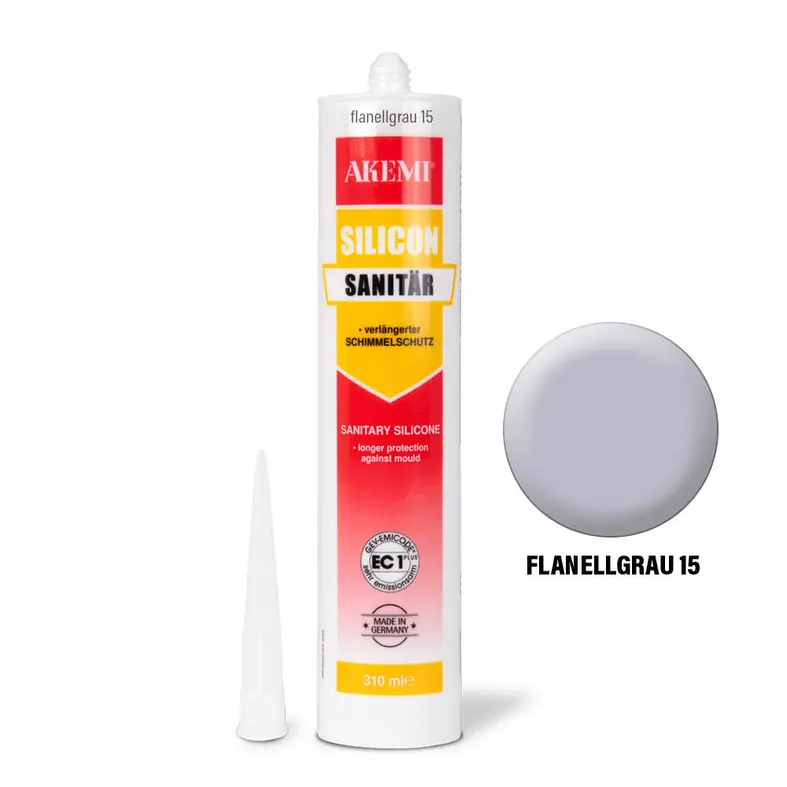
What brings a tiler back to site after two years is rarely the sealant. It is the joint that sticks to the base. If the silicone adheres not only to both flanks but to the joint base as well, it cannot absorb movement across the free cross-section — and it tears.
Flannel grey 15 is one of AKEMI's warm greys in this range. What sits beneath it decides the service life.
AKEMI® Sanitary Silicone is a special joint-sealing material for expansion and connecting joints in kitchens, living and sanitary areas on ceramic tiles. Approved for interior and exterior use. Excellent and durable adhesion on non-porous silicate materials: glass, glazed ceramics, tiles, clinker, glass ceramics, email, porcelain and aluminium.
The manufacturer puts it briefly: to avoid adhesion on three flanks and in case of deep joints, use back-filling cords. The cord has two jobs — it limits the joint depth and it prevents the sealant from adhering to the base.
The material choice is not arbitrary. For humid room applications as well as in outdoor and permanent wet areas, use closed-cell PE back-filling cords; otherwise use open-cell PUR back-filling cords. The reason lies in the material: closed-cell polyethylene is not water-absorbent and rot-free; open-cell polyurethane is not. In showers, bathrooms and outdoors, PE is therefore the only correct choice. AKEMI supplies the PE cords in grey and the PUR cords in yellow — the fastest distinction on site.
Joint size at least 5 x 3 mm (width x depth). The cord must be selected so that this minimum depth is preserved.
Then there is substrate preparation: contact surfaces dry, clean, free of grease and dust. Clean with AKEMI® Cleaner A on tiles, ceramics, glass, non-painted wood and metal; AKEMI® Cleaner I on plastics and painted surfaces. Mask off surfaces in the area of the joint edges with special adhesive tape.
Depending on the substrate and subsequent loads, adhesion can be improved using cleaners and primers — AKEMI names Clean Primer AP 40 for non-porous surfaces and Primer AP 10 for porous or absorbent surfaces. Important: do not apply the primer to visible surfaces, or staining may result.
| Colour | flannel grey 15 (AKEMI item number 40015) |
| Container | 1C-cartridge, 310 ml |
| System | acetate cross-linked |
| Permissible total deformation | 20 % |
| Working temperature | +5 °C to +35 °C |
| Temperature resistance | -50 °C to +180 °C |
| Skin formation time (23 °C, 50 % RH) | approx. 15 minutes |
| Hardening (23 °C, 50 % RH) | approx. 2 mm per 24 hours |
| Shore A hardness / modulus | ~22 / 0.44 N/mm² |
| Storage | 5–25 °C, unopened at least 24 months |
Full characteristic values, test standards and processing instructions: see the manufacturer's Technical Data Sheet.
| Joint width x depth | Metres per cartridge |
|---|---|
| 5 x 5 mm | 12 |
| 10 x 10 mm | 3 |
| 15 x 10 mm | 2 |
| 20 x 15 mm | 1 |
Full instructions for use in the manufacturer's Technical Data Sheet.
For professional use only. Not suited for porous, absorbent surfaces like natural and artificial stone — danger of discolouring in the marginal zone. AKEMI offers dedicated neutral cross-linked products for natural stone.
EN 15651-3 (XS1) · EN 15651-4 (PW20LM Ext.-Int.) · GEV EMICODE® EC1PLUS · VOC France emission class A+ · REACH compliant (EU No. 1907/2006) · IVD-leaflets 3-1 and 14.
Sanitary Silicone Akemi transparent 01 (Art. No. 16255) · Sanitary Silicone Akemi white 02 (Art. No. 16256) · Sanitary Silicone Akemi silver grey 05 (Art. No. 16259) · Sanitary Silicone Akemi pale grey 11 (Art. No. 16264) · Sanitary Silicone Akemi bright grey 12 (Art. No. 16265) · Sanitary Silicone Akemi stone grey 17 (Art. No. 16270) · Sanitary Silicone Akemi sanitary grey 18 (Art. No. 16271) · Sanitary Silicone Akemi grey 22 (Art. No. 16275) · Sanitary Silicone Akemi anthracite 23 (Art. No. 16276) · Sanitary Silicone Akemi cloud grey 74 (Art. No. 16300) · Sanitary Silicone Akemi fog 82 (Art. No. 16304)
Movement is then no longer absorbed across the free cross-section but produces stress peaks instead — and the joint tears open. This is why the manufacturer explicitly requires back-filling cords to avoid adhesion on three flanks and in the case of deeper joints.
The PE back-filling cords (polyethylene) are closed-cell, not water-absorbent, rot-free and grey. The PUR back-filling cords (polyurethane) are open-cell, yellow, and supplied in 1 m lengths in a carton. For damp rooms and outdoor use, only the grey PE version is permissible.
AKEMI requires back-filling cords to avoid adhesion on three flanks and in the case of deeper joints, and differentiates between PE and PUR. Adhesive tape appears elsewhere in the data sheet — for masking off surfaces in the area of the joint edges, not as a bond breaker at the joint base. Follow the manufacturer's specification; for deviations, contact our e-commerce team.
Depending on the type and condition of the surface material as well as subsequent loads — tensile and shear forces, exposure to temperature, humidity and other media — adhesion can be improved by using cleaners and primers. AKEMI names Clean Primer AP 40 for non-porous surfaces and Primer AP 10 for porous or absorbent surfaces. To avoid staining, the primer must not be applied to visible surfaces.


