


Sale


EUR
25,00 Excl. VAT
*
EUR
29,75 VAT included
*
RRP: € 60,00
In Stock


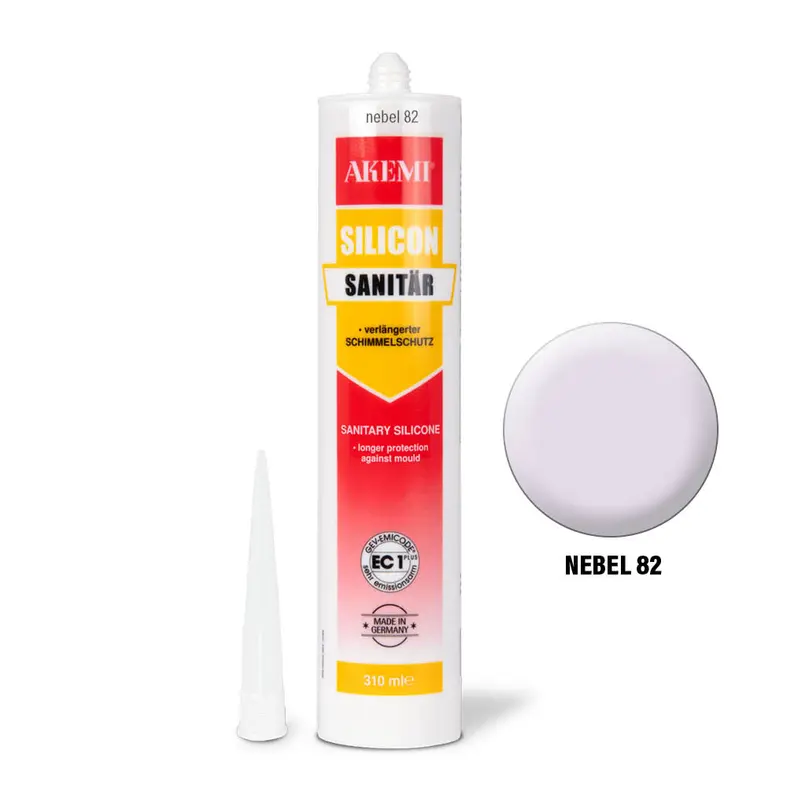
On housing and refurbishment work nobody asks about emission classification. On projects with indoor air requirements — nurseries, schools, care homes, certified buildings — it is the first thing asked. And then an abbreviation on the cartridge decides whether the product may be installed at all.
Fog 82 is one of AKEMI's soft greys in this range. The emission classification applies to the whole Sanitary Silicone.
AKEMI® Sanitary Silicone is a special joint-sealing material for expansion and connecting joints in kitchens, living and sanitary areas on ceramic tiles. Approved for interior and exterior use. Excellent and durable adhesion on non-porous silicate materials: glass, glazed ceramics, tiles, clinker, glass ceramics, email, porcelain and aluminium.
GEV EMICODE® EC1PLUS — very low emission. EMICODE is the classification system of GEV (Association for the Control of Emissions in Products for Flooring Installation). EC1PLUS is the strictest level within that system; AKEMI lists the Sanitary Silicone in this classification.
Emission class A+. This is the French VOC labelling, mandatory on construction products in France. There, A+ denotes the lowest emission level. The manufacturer lists both classifications — EMICODE and VOC France — side by side in the data sheet.
REACH. The product is compliant with regulation (EU) No. 1907/2006.
What this means for the finished joint. After hardening the sealant is odourless and physiologically harmless, and the hardened sealant is not harmful to health. During application, nonetheless: use AKEMI® The Liquid Glove to protect your hands — and read the Safety Data Sheet. Acetic acid is released during hardening.
What the data sheet does not say. Whether and how these classifications count towards a specific building certification is not covered by the Technical Data Sheet. For evidence towards clients or certifiers, refer to the manufacturer's documentation; our e-commerce team will help you obtain it.
| Colour | fog 82 (AKEMI item number 40082) |
| Container | 1C-cartridge, 310 ml |
| System | acetate cross-linked |
| Permissible total deformation | 20 % |
| Working temperature | +5 °C to +35 °C |
| Temperature resistance | -50 °C to +180 °C |
| Skin formation time (23 °C, 50 % RH) | approx. 15 minutes |
| Hardening (23 °C, 50 % RH) | approx. 2 mm per 24 hours |
| Shore A hardness / modulus | ~22 / 0.44 N/mm² |
| Storage | 5–25 °C, unopened at least 24 months |
Full characteristic values, test standards and processing instructions: see the manufacturer's Technical Data Sheet.
| Joint width x depth | Metres per cartridge |
|---|---|
| 5 x 5 mm | 12 |
| 10 x 10 mm | 3 |
| 15 x 10 mm | 2 |
| 20 x 15 mm | 1 |
Full instructions for use in the manufacturer's Technical Data Sheet.
For professional use only. Not suited for porous, absorbent surfaces like natural and artificial stone — danger of discolouring in the marginal zone. AKEMI offers dedicated neutral cross-linked products for natural stone.
EN 15651-3 (XS1) · EN 15651-4 (PW20LM Ext.-Int.) · GEV EMICODE® EC1PLUS · VOC France emission class A+ · REACH compliant (EU No. 1907/2006) · IVD-leaflets 3-1 and 14.
Sanitary Silicone Akemi transparent 01 (Art. No. 16255) · Sanitary Silicone Akemi white 02 (Art. No. 16256) · Sanitary Silicone Akemi silver grey 05 (Art. No. 16259) · Sanitary Silicone Akemi pale grey 11 (Art. No. 16264) · Sanitary Silicone Akemi bright grey 12 (Art. No. 16265) · Sanitary Silicone Akemi flannel grey 15 (Art. No. 16268) · Sanitary Silicone Akemi stone grey 17 (Art. No. 16270) · Sanitary Silicone Akemi sanitary grey 18 (Art. No. 16271) · Sanitary Silicone Akemi grey 22 (Art. No. 16275) · Sanitary Silicone Akemi anthracite 23 (Art. No. 16276) · Sanitary Silicone Akemi cloud grey 74 (Art. No. 16300)
The manufacturer lists AKEMI® Sanitary Silicone as very low emission according to GEV EMICODE® EC1PLUS. EMICODE is the system of the Association for the Control of Emissions in Products for Flooring Installation; EC1PLUS denotes its strictest level. The classification applies to every shade in the range.
The Technical Data Sheet lists it under "VOC France: emission class A+" alongside the EMICODE classification. Both labels concern volatile organic compounds but come from different systems, which is why they are stated separately.
The vinegar smell during application comes from the acetic acid that the acetate cross-linked product releases as it hardens. Once hardened through, the sealant is odourless, physiologically harmless and, according to the manufacturer, not harmful to health.
In addition: read the Safety Data Sheet before handling or using this product. The favourable emission classification of the hardened product changes nothing about protective measures during application — acetic acid is released at that stage.


