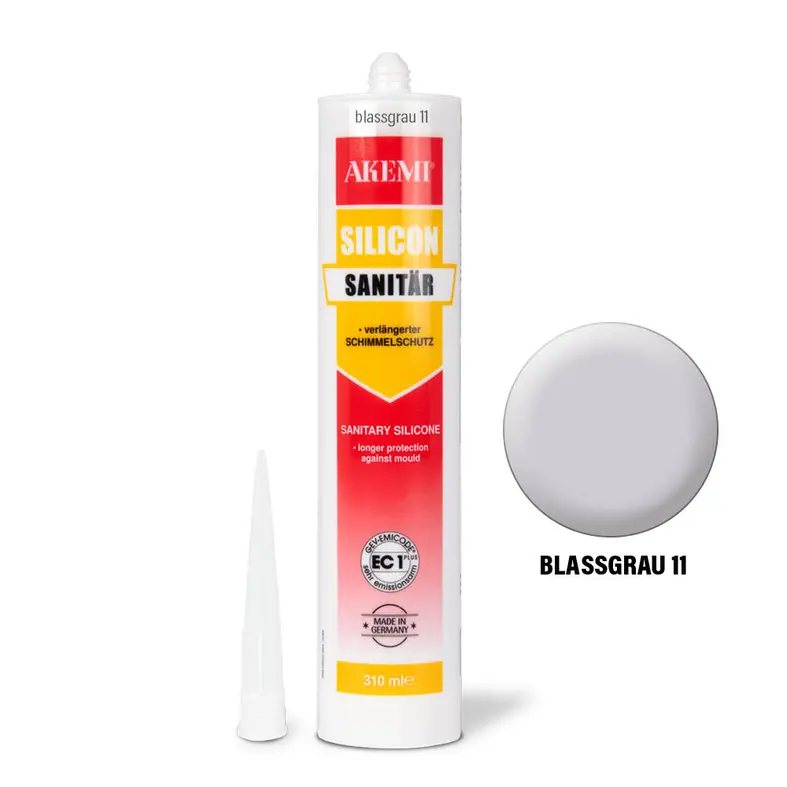
Sanitary Silicone Akemi pale grey 11 and correct joint dimensioning
The most common cause of a cracked silicone joint is not the sealant. It is the cross-section. A joint planned too narrow or filled too deep cannot absorb the movement of the component — and tears at its weakest point, usually along a flank.
Pale grey 11 is one of AKEMI's light greys in this range. The figures that matter during execution apply equally to every shade of the Sanitary Silicone — here they take centre stage.
Application area
AKEMI® Sanitary Silicone is a special joint-sealing material for expansion and connecting joints in kitchens, living and sanitary areas on ceramic tiles. Approved for interior and exterior use. Excellent and durable adhesion on non-porous silicate materials: glass, glazed ceramics, tiles, clinker, glass ceramics, email, porcelain and aluminium.
Joint cross-section and movement absorption: the figures that count
Minimum joint size 5 x 3 mm (width x depth). That is the manufacturer's lower limit, not a recommendation. Below it, the sealant cross-section is too small to absorb movement elastically.
Permissible total deformation 20 %. The joint may deform by up to 20 % of its width. In practice: the expected movement of the component determines the joint width, not the appearance. Working with 4 mm width leaves 0.8 mm of theoretical margin — on a bath that settles as it fills, that is used up quickly.
Avoid adhesion on three flanks. If the sealant also adheres to the joint base it cannot stretch freely and tears. For deeper joints, insert a back-filling cord: closed-cell PE cords for humid room applications and outdoors, otherwise open-cell PUR cords.
The elasticity figures at a glance. Shore A hardness ~22, modulus (DIN EN ISO 8339) 0.44 N/mm², breaking stress ~0.7 N/mm², elongation at break ~180 %. The product is classified as PW20LM Ext.-Int. according to EN 15651-4 — LM denotes the low-modulus type, which absorbs movement with low restoring force and therefore stresses the flanks less.
The rest is craft: dry flanks, contact surfaces free of grease and dust, working temperature between +5 °C and +35 °C, smoothing within 10 to 15 minutes.
Technical data
| Colour |
pale grey 11 (AKEMI item number 40011) |
| Container |
1C-cartridge, 310 ml |
| System |
acetate cross-linked |
| Permissible total deformation |
20 % |
| Working temperature |
+5 °C to +35 °C |
| Temperature resistance |
-50 °C to +180 °C |
| Skin formation time (23 °C, 50 % RH) |
approx. 15 minutes |
| Hardening (23 °C, 50 % RH) |
approx. 2 mm per 24 hours |
| Shore A hardness / modulus |
~22 / 0.44 N/mm² |
| Storage |
5–25 °C, unopened at least 24 months |
Full characteristic values, test standards and processing instructions: see the manufacturer's Technical Data Sheet.
Consumption per cartridge
| Joint width x depth |
Metres per cartridge |
| 5 x 5 mm |
12 |
| 10 x 10 mm |
3 |
| 15 x 10 mm |
2 |
| 20 x 15 mm |
1 |
Application in brief
- Contact surfaces dry, clean, free of grease and dust; clean with AKEMI® Cleaner A (tiles, ceramics, glass, non-painted wood, metal) or Cleaner I (plastics, painted surfaces).
- Joint size min. 5 x 3 mm. Insert back-filling cords to avoid adhesion on three flanks: closed-cell PE in damp rooms and outdoors, otherwise open-cell PUR. Mask off the joint edges.
- Apply at +5 °C to +35 °C with dry flanks. Smoothen within 10–15 minutes using a smoothing rubber and smoothing agent; remove excess smoothing agent.
- Remove the masking tape before the skin forms, pulling towards the joint. Clean tools with AKEMI® Cleaner A.
Full instructions for use in the manufacturer's Technical Data Sheet.
Important restrictions
For professional use only. Not suited for porous, absorbent surfaces like natural and artificial stone — danger of discolouring in the marginal zone. AKEMI offers dedicated neutral cross-linked products for natural stone.
- Releases acetic acid during hardening — not on or near acid- or corrosion-sensitive materials (iron, copper, brass, zinc, lead, concrete, materials containing lime or cement).
- No sufficient adhesion on silicone, PE, PP, PTFE, butyl rubber, neoprene, EPDM or plasticised plastics.
- Discolouration on tar- and bitumen-coated surfaces as well as elastomers (EPDM, APTC, neoprene).
- On wood, metal, paints, plastics, stainless steel and sanitary acrylate no general prediction is possible — test adhesion and compatibility beforehand.
- Not for the construction of aquariums. Read the Safety Data Sheet.
Conformity
EN 15651-3 (XS1) · EN 15651-4 (PW20LM Ext.-Int.) · GEV EMICODE® EC1PLUS · VOC France emission class A+ · REACH compliant (EU No. 1907/2006) · IVD-leaflets 3-1 and 14.
Further colours in this range
Sanitary Silicone Akemi transparent 01 (Art. No. 16255) · Sanitary Silicone Akemi white 02 (Art. No. 16256) · Sanitary Silicone Akemi silver grey 05 (Art. No. 16259) · Sanitary Silicone Akemi bright grey 12 (Art. No. 16265) · Sanitary Silicone Akemi flannel grey 15 (Art. No. 16268) · Sanitary Silicone Akemi stone grey 17 (Art. No. 16270) · Sanitary Silicone Akemi sanitary grey 18 (Art. No. 16271) · Sanitary Silicone Akemi grey 22 (Art. No. 16275) · Sanitary Silicone Akemi anthracite 23 (Art. No. 16276) · Sanitary Silicone Akemi cloud grey 74 (Art. No. 16300) · Sanitary Silicone Akemi fog 82 (Art. No. 16304)
What is the minimum joint width and depth?
At least 5 x 3 mm — width x depth.
This is the lower limit specified by the manufacturer for AKEMI® Sanitary Silicone. It applies regardless of shade. For deeper joints, back-filling cords must be inserted to avoid adhesion on three flanks: closed-cell PE cords for humid room applications and outdoors, otherwise open-cell PUR cords.
What does 20 % movement absorption mean in practice?
The joint may deform by up to 20 % of its width.
Permissible total deformation is stated as 20 % in the Technical Data Sheet. For execution this means the joint width must follow the expected movement of the component. At 10 mm joint width, 2 mm of movement is theoretically available; at 5 mm only 1 mm. Exceed that and the joint is overloaded — no matter how carefully it was tooled.
Why must the silicone not adhere on three flanks?
Because it then cannot stretch freely and tears open.
If the sealant adheres to the joint base as well as to both flanks, movement is not absorbed across the free cross-section but produces stress peaks instead. This is why the manufacturer explicitly requires back-filling cords to avoid adhesion on three flanks and in the case of deeper joints.
Which back-filling cord do I need in a damp room?
Closed-cell PE cords.
For humid room applications and in outdoor and permanent wet areas, closed-cell PE back-filling cords are required; otherwise open-cell PUR cords are used. The difference is functional: closed-cell polyethylene is not water-absorbent and rot-free, open-cell polyurethane is not. In bathrooms and showers, PE is therefore the only correct choice.
Do you have any questions on this item?