


New

EUR
5,49 Excl. VAT
*
EUR
6,53 VAT included
*
RRP: € 8,95
In Stock


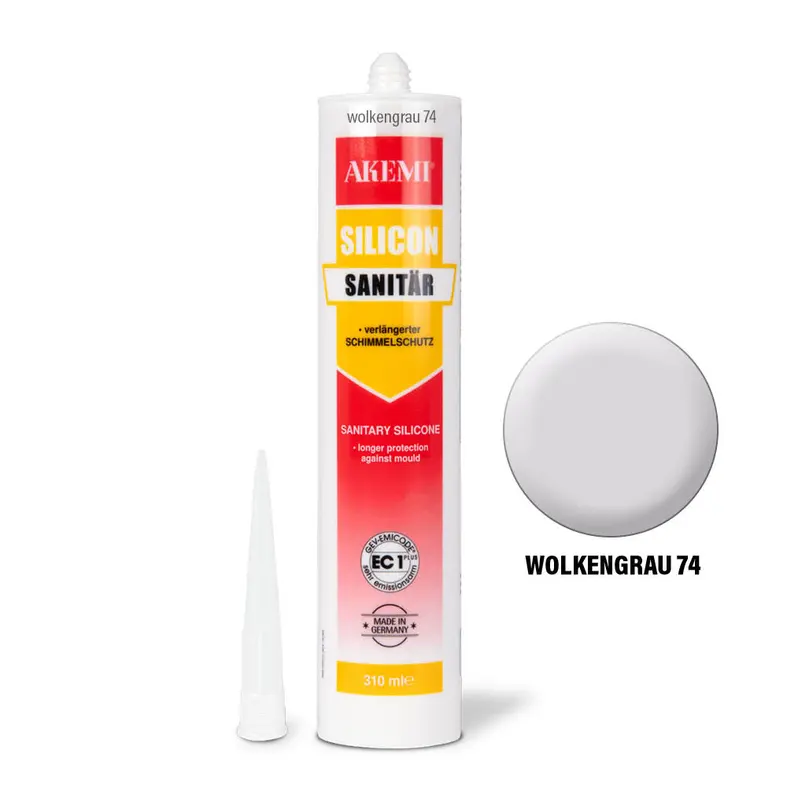
Two temperature figures appear in the data sheet, and they get confused all the time. Temperature resistant -50 °C to +180 °C applies to the hardened joint. Working temperature +5 °C to +35 °C applies to the moment you are holding the cartridge. Read the first and skip the second, and you seal at 2 °C in January — and remake the joint in spring.
Cloud grey 74 is one of AKEMI's restrained greys in this range. The temperature limits apply to every shade.
AKEMI® Sanitary Silicone is a special joint-sealing material for expansion and connecting joints in kitchens, living and sanitary areas on ceramic tiles. Approved for interior and exterior use. Excellent and durable adhesion on non-porous silicate materials: glass, glazed ceramics, tiles, clinker, glass ceramics, email, porcelain and aluminium.
Working temperature +5 °C to +35 °C. That is the manufacturer's specification, with no margin at the bottom. Alongside a condition that is the real sticking point in winter: the flanks must be dry. Condensation forms on a cold tile in an unfinished building as soon as warm air arrives — and condensation on a flank is not a dry flank.
Why cold slows hardening. AKEMI® Sanitary Silicone is a 1-component sealant that hardens in contact with atmospheric moisture. The manufacturer explicitly names layer thickness, temperature and relative atmospheric humidity as the factors governing hardening. The reference figures — skin formation approx. 15 minutes, hardening approx. 2 mm per 24 hours — apply at 23 °C and 50 % rel. air humidity. The data sheet gives no concrete figures for other conditions.
Storage. Stored dry and cool between 5 °C and 25 °C in the closed original container, the product keeps at least 24 months from production. An unheated van overnight in January falls outside that range — as does a loft store in high summer.
What helps and what does not. Heating the room and letting it come up to temperature brings you into the permissible range. A pre-warmed cartridge alone does not: working temperature refers to conditions at the joint, and the flanks are as cold as the room. The Technical Data Sheet does not distinguish between air and substrate temperature here — in case of doubt, the lower figure applies.
| Colour | cloud grey 74 (AKEMI item number 40074) |
| Container | 1C-cartridge, 310 ml |
| System | acetate cross-linked |
| Permissible total deformation | 20 % |
| Working temperature | +5 °C to +35 °C |
| Temperature resistance | -50 °C to +180 °C |
| Skin formation time (23 °C, 50 % RH) | approx. 15 minutes |
| Hardening (23 °C, 50 % RH) | approx. 2 mm per 24 hours |
| Shore A hardness / modulus | ~22 / 0.44 N/mm² |
| Storage | 5–25 °C, unopened at least 24 months |
Full characteristic values, test standards and processing instructions: see the manufacturer's Technical Data Sheet.
| Joint width x depth | Metres per cartridge |
|---|---|
| 5 x 5 mm | 12 |
| 10 x 10 mm | 3 |
| 15 x 10 mm | 2 |
| 20 x 15 mm | 1 |
Full instructions for use in the manufacturer's Technical Data Sheet.
For professional use only. Not suited for porous, absorbent surfaces like natural and artificial stone — danger of discolouring in the marginal zone. AKEMI offers dedicated neutral cross-linked products for natural stone.
EN 15651-3 (XS1) · EN 15651-4 (PW20LM Ext.-Int.) · GEV EMICODE® EC1PLUS · VOC France emission class A+ · REACH compliant (EU No. 1907/2006) · IVD-leaflets 3-1 and 14.
Sanitary Silicone Akemi transparent 01 (Art. No. 16255) · Sanitary Silicone Akemi white 02 (Art. No. 16256) · Sanitary Silicone Akemi silver grey 05 (Art. No. 16259) · Sanitary Silicone Akemi pale grey 11 (Art. No. 16264) · Sanitary Silicone Akemi bright grey 12 (Art. No. 16265) · Sanitary Silicone Akemi flannel grey 15 (Art. No. 16268) · Sanitary Silicone Akemi stone grey 17 (Art. No. 16270) · Sanitary Silicone Akemi sanitary grey 18 (Art. No. 16271) · Sanitary Silicone Akemi grey 22 (Art. No. 16275) · Sanitary Silicone Akemi anthracite 23 (Art. No. 16276) · Sanitary Silicone Akemi fog 82 (Art. No. 16304)
The manufacturer specifies a range of +5 °C to +35 °C. Below that the product is not approved. Heat the room and let the substrate come up to temperature before you start — and make sure the flanks stay dry while you do.
Temperature resistance of -50 °C to +180 °C describes what the finished joint withstands in service. The working temperature of +5 °C to +35 °C describes the conditions under which it may be created at all. The two figures have nothing to do with each other.
AKEMI® Sanitary Silicone is a 1-component joint-sealing material based on silicone rubber which hardens in contact with atmospheric moisture. The manufacturer names layer thickness, temperature and relative atmospheric humidity as the factors governing hardening. The reference figures — skin formation approx. 15 minutes, hardening approx. 2 mm per 24 hours — refer to 23 °C and 50 % relative air humidity. The data sheet gives no figures for deviating conditions.
Stored dry and cool within that range, in the closed original container, the product keeps at least 24 months from production. An unheated van in January and a loft store in August both fall outside it.


