


New

EUR
5,49 Excl. VAT
*
EUR
6,53 VAT included
*
RRP: € 8,95
In Stock


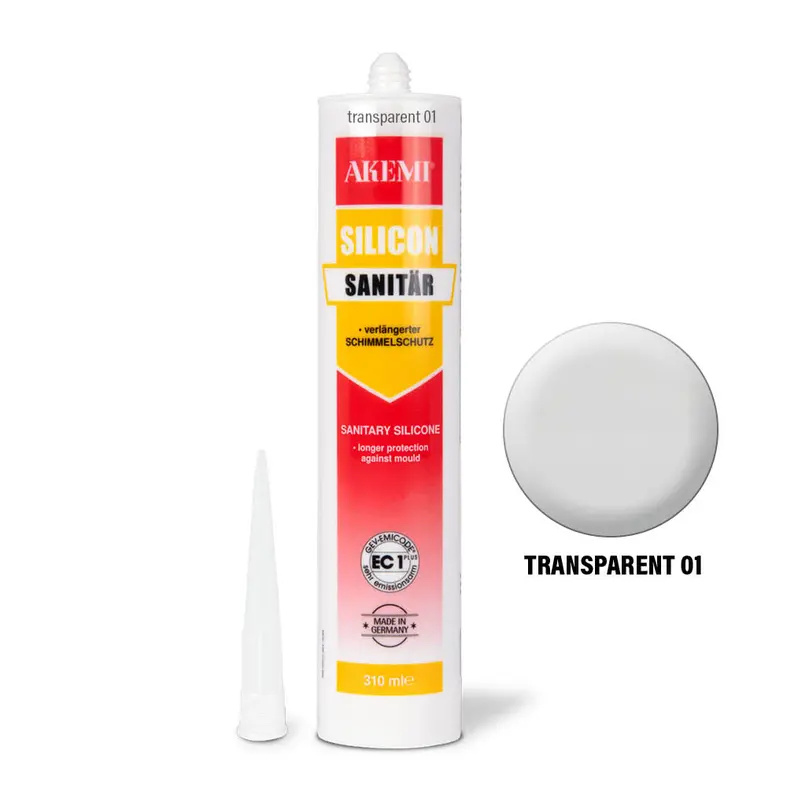
Every coloured sealant starts with the same question: which shade matches the grout, the tile, the sanitary ware? With transparent 01 that question never comes up. The colourless shade is the choice wherever colour matching is impossible or simply unwanted — on glass shower screens and enclosures, on glass blocks, on multi-coloured or patterned tiling, on mosaic work.
AKEMI® Sanitary Silicone is a special joint-sealing material for expansion and connecting joints in kitchens, living and sanitary areas on ceramic tiles. Approved for interior and exterior use. Excellent and durable adhesion on non-porous silicate materials: glass, glazed ceramics, tiles, clinker, glass ceramics, email, porcelain and aluminium.
AKEMI® Sanitary Silicone achieves excellent and durable adhesion on non-porous silicate materials — the manufacturer names glass, glazed ceramics, tiles, clinker, glass ceramics, email and porcelain, as well as aluminium. That is exactly the environment in which the colourless shade gets used: shower enclosure, glass partition, glass block.
Two points from practice. First: how visible the joint remains depends on joint width, joint depth and the substrate behind it. On a dark or heavily textured substrate the preliminary trial is particularly worthwhile — the manufacturer obliges the user to trial the product in an inconspicuous area or produce a sample piece anyway.
Second: on mosaic and small-format tiles the minimum joint size of 5 x 3 mm (width x depth) quickly becomes the issue. The connecting joint must not be executed narrower — not even if the joint pattern seems to call for it.
| Colour | transparent 01 (AKEMI item number 40001) |
| Container | 1C-cartridge, 310 ml |
| System | acetate cross-linked |
| Permissible total deformation | 20 % |
| Working temperature | +5 °C to +35 °C |
| Temperature resistance | -50 °C to +180 °C |
| Skin formation time (23 °C, 50 % RH) | approx. 15 minutes |
| Hardening (23 °C, 50 % RH) | approx. 2 mm per 24 hours |
| Shore A hardness / modulus | ~22 / 0.44 N/mm² |
| Storage | 5–25 °C, unopened at least 24 months |
Full characteristic values, test standards and processing instructions: see the manufacturer's Technical Data Sheet.
| Joint width x depth | Metres per cartridge |
|---|---|
| 5 x 5 mm | 12 |
| 10 x 10 mm | 3 |
| 15 x 10 mm | 2 |
| 20 x 15 mm | 1 |
Full instructions for use in the manufacturer's Technical Data Sheet.
For professional use only. Not suited for porous, absorbent surfaces like natural and artificial stone — danger of discolouring in the marginal zone. AKEMI offers dedicated neutral cross-linked products for natural stone.
EN 15651-3 (XS1) · EN 15651-4 (PW20LM Ext.-Int.) · GEV EMICODE® EC1PLUS · VOC France emission class A+ · REACH compliant (EU No. 1907/2006) · IVD-leaflets 3-1 and 14.
Sanitary Silicone Akemi white 02 (Art. No. 16256) · Sanitary Silicone Akemi silver grey 05 (Art. No. 16259) · Sanitary Silicone Akemi pale grey 11 (Art. No. 16264) · Sanitary Silicone Akemi bright grey 12 (Art. No. 16265) · Sanitary Silicone Akemi flannel grey 15 (Art. No. 16268) · Sanitary Silicone Akemi stone grey 17 (Art. No. 16270) · Sanitary Silicone Akemi sanitary grey 18 (Art. No. 16271) · Sanitary Silicone Akemi grey 22 (Art. No. 16275) · Sanitary Silicone Akemi anthracite 23 (Art. No. 16276) · Sanitary Silicone Akemi cloud grey 74 (Art. No. 16300) · Sanitary Silicone Akemi fog 82 (Art. No. 16304)
The manufacturer explicitly names glass, glazed ceramics, tiles, clinker, glass ceramics, email and porcelain, as well as aluminium. For connecting joints on shower enclosures, glass partitions and glass blocks, transparent 01 is the obvious choice.
How noticeable the joint is depends on joint width, joint depth and the substrate. The manufacturer generally recommends trialling the product in an inconspicuous area or producing a sample piece — with transparent 01 particularly so when the substrate behind the joint is dark or heavily textured.
Natural and artificial stone are explicitly excluded. In addition, the sealant releases acetic acid as it hardens, which is why use on or near acid-sensitive materials is not recommended. Prolonged contact with materials that can absorb migratory components — natural stone among them — must basically be avoided. AKEMI offers dedicated neutral cross-linked silicones for that.
Full hardening progresses at roughly 2 mm per 24 hours. In practice: smoothing happens within 10 to 15 minutes, and the masking tape must be removed before the skin forms. A joint 10 mm deep needs several days to harden through.


