


New

EUR
5,49 Excl. VAT
*
EUR
6,53 VAT included
*
RRP: € 8,95
In Stock


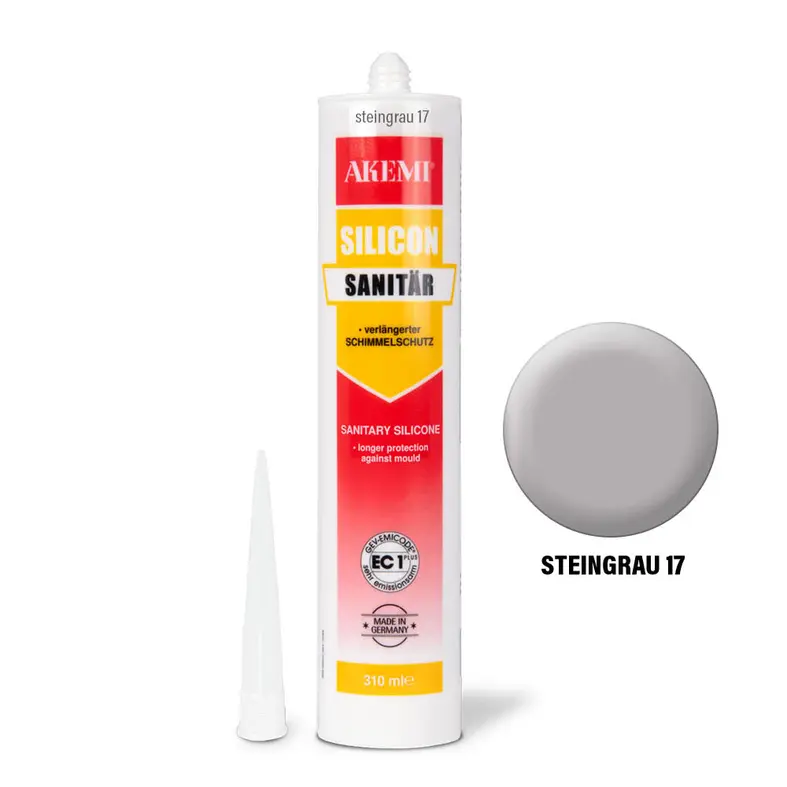
This shade is called stone grey. That is a colour designation, not an application recommendation — and this is exactly where the most expensive mistake on site happens. AKEMI® Sanitary Silicone is explicitly not suited for natural and artificial stone. Not in stone grey either.
The reason is chemical, not visual: the product is acetate cross-linked and releases acetic acid during hardening. On porous, absorbent substrates there is a danger of discolouring in the marginal zone — a dark seam along the joint that cannot be removed afterwards.
AKEMI® Sanitary Silicone is a special joint-sealing material for expansion and connecting joints in kitchens, living and sanitary areas on ceramic tiles. Approved for interior and exterior use. Excellent and durable adhesion on non-porous silicate materials: glass, glazed ceramics, tiles, clinker, glass ceramics, email, porcelain and aluminium.
The manufacturer is unambiguous here: not suited for porous, absorbent surfaces like natural and artificial stone; danger of discolouring in the marginal zone!
Two mechanisms act together. First: AKEMI® Sanitary Silicone releases acetic acid during hardening. Use on or near acid- or corrosion-sensitive materials such as iron, copper, brass, zinc, lead, concrete or building materials containing lime or cement is therefore not recommended. Marble and limestone contain lime.
Second: prolonged contact with materials which release migratory components or can absorb them must basically be avoided — and the manufacturer names natural stone explicitly on the absorbing side. The porous stone draws constituents out of the sealant into the marginal zone. The result is visible and permanent.
Where stone grey 17 is right: on ceramic tiles, glazed ceramics, clinker, enamel, glass, painted wood and plastics — the classic tiling environment. Excellent and durable adhesion is achieved on non-porous silicate materials.
Where it does not belong: natural and artificial stone of any kind, including composite and quartz materials. AKEMI offers dedicated neutral cross-linked silicones for these substrates — among them Marble Silicone and Stone Silicone, which work without discolouration in the contact area.
| Colour | stone grey 17 (AKEMI item number 40017) |
| Container | 1C-cartridge, 310 ml |
| System | acetate cross-linked |
| Permissible total deformation | 20 % |
| Working temperature | +5 °C to +35 °C |
| Temperature resistance | -50 °C to +180 °C |
| Skin formation time (23 °C, 50 % RH) | approx. 15 minutes |
| Hardening (23 °C, 50 % RH) | approx. 2 mm per 24 hours |
| Shore A hardness / modulus | ~22 / 0.44 N/mm² |
| Storage | 5–25 °C, unopened at least 24 months |
Full characteristic values, test standards and processing instructions: see the manufacturer's Technical Data Sheet.
| Joint width x depth | Metres per cartridge |
|---|---|
| 5 x 5 mm | 12 |
| 10 x 10 mm | 3 |
| 15 x 10 mm | 2 |
| 20 x 15 mm | 1 |
Full instructions for use in the manufacturer's Technical Data Sheet.
For professional use only. Not suited for porous, absorbent surfaces like natural and artificial stone — danger of discolouring in the marginal zone. AKEMI offers dedicated neutral cross-linked products for natural stone.
EN 15651-3 (XS1) · EN 15651-4 (PW20LM Ext.-Int.) · GEV EMICODE® EC1PLUS · VOC France emission class A+ · REACH compliant (EU No. 1907/2006) · IVD-leaflets 3-1 and 14.
Sanitary Silicone Akemi transparent 01 (Art. No. 16255) · Sanitary Silicone Akemi white 02 (Art. No. 16256) · Sanitary Silicone Akemi silver grey 05 (Art. No. 16259) · Sanitary Silicone Akemi pale grey 11 (Art. No. 16264) · Sanitary Silicone Akemi bright grey 12 (Art. No. 16265) · Sanitary Silicone Akemi flannel grey 15 (Art. No. 16268) · Sanitary Silicone Akemi sanitary grey 18 (Art. No. 16271) · Sanitary Silicone Akemi grey 22 (Art. No. 16275) · Sanitary Silicone Akemi anthracite 23 (Art. No. 16276) · Sanitary Silicone Akemi cloud grey 74 (Art. No. 16300) · Sanitary Silicone Akemi fog 82 (Art. No. 16304)
AKEMI® Sanitary Silicone is not suited for porous, absorbent surfaces like natural and artificial stone; there is a danger of discolouring in the marginal zone. This applies to every shade in the range, stone grey 17 included. For natural stone AKEMI offers dedicated neutral cross-linked products such as Marble Silicone and Stone Silicone.
The manufacturer notes that prolonged contact with materials which release migratory components or can absorb them — natural stone is named explicitly — must basically be avoided. On porous, absorbent surfaces there is a danger of discolouring in the marginal zone. It appears in the marginal zone of the joint and cannot be reversed.
Use on or near acid- or corrosion-sensitive materials such as iron, copper, brass, zinc, lead, concrete or building materials containing lime or cement is not recommended. Discolouration may also occur in contact with non-ferrous metals such as copper or brass — relevant around fittings and exposed pipework.
Porcelain stoneware is a ceramic tile, and that is exactly what AKEMI® Sanitary Silicone is intended for: expansion and connecting joints in kitchens, living and sanitary areas on ceramic tiles. A tile that looks like marble is not a marble slab. On unclear or unknown substrates the manufacturer requires a test of adhesion and compatibility beforehand.


