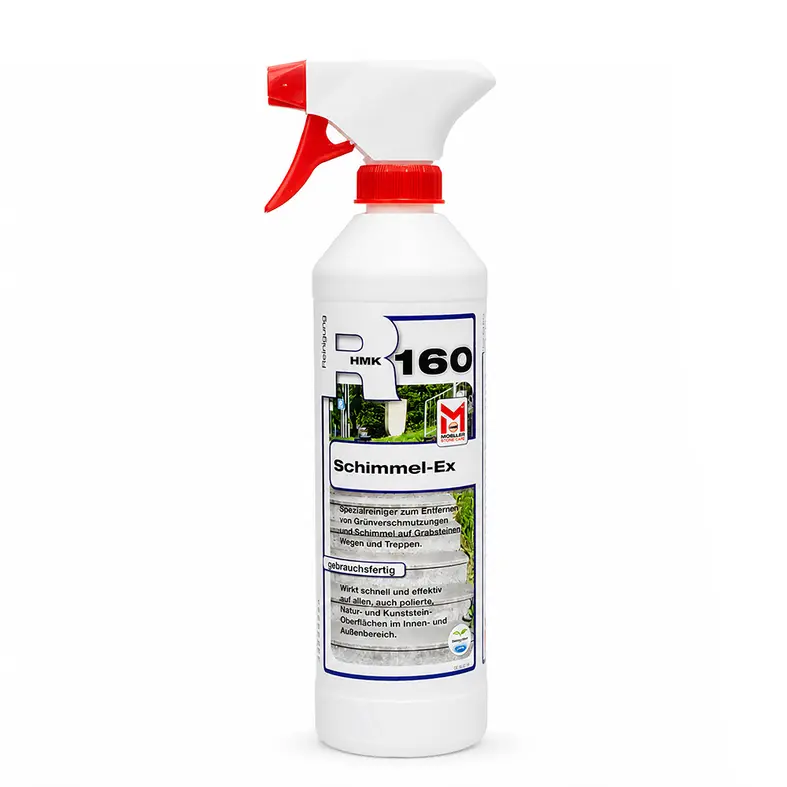
Mould Remover HMK R160 0,475L – Mould and Green Growth Remover for Natural Stone, Tiles, and Concrete
Green growth, algae, and mould develop particularly on damp, shaded, or heavily weathered surfaces such as patios, balconies, garden pathways, facades, gravestones, and in wet or shower areas. Normal household cleaners quickly reach their limits here because organic deposits can penetrate deep into structured or porous surfaces. HMK R160 Mould Remover is a powerful special cleaner for the rapid removal of mould, green growth, and organic deposits on suitable surfaces indoors and outdoors. The cleaner is suitable for natural stone, tiles, ceramics, concrete, paving stones, facade surfaces, walkways, and gravestones
Advantages of HMK R160 Mould Remover at a Glance:
- Removes mould, green growth, algae, and organic deposits reliably
- Fast cleaning action for patios, balconies, garden pathways, driveways, facades, and wet areas
- Suitable for natural stone, tiles, ceramics, concrete, paving stones, and gravestones
- Can be used indoors and outdoors
- Easy application for private customers, stonemasons, building cleaners, and landscapers
- Economical in use thanks to concentrated liquid formula
- Practical for small surfaces as a 0.475 l spray bottle and for larger areas in a 5 l container
- Coverage: approx. 5–10 m² per litre, depending on the surface and level of dirt
HMK R160 Mould Remover for Household, Trade, and Outdoor Surfaces:
HMK R160 Mould Remover is suitable for typical cleaning tasks in private and commercial areas. In the household, the cleaner is used on patios, balconies, garden paths, driveways, bathroom surfaces, and other wet areas. Even with gravestones, facades, or weathered outdoor surfaces, HMK R160 Mould Remover helps to visibly eliminate mould and green growth, making the surface look clean again. For professional users such as stonemasons, building cleaners, tilers, and landscapers, the cleaner is particularly interesting when surfaces need to be treated efficiently and evenly. Especially on textured tiles, open-porous concrete surfaces, paving stones, or natural stone surfaces, green growth and mould often stick stubbornly; the cleaner reduces the mechanical effort of scrubbing here.
Technical Data of HMK R160 Mould Remover:
- Product name: HMK R160 Mould Remover
- Product type: Mould and green growth remover
- Form: Liquid special cleaner
- Area of application: Indoors and outdoors
- Suitable for: Natural stone, tiles, ceramics, concrete, paving stones, facades, walkways, and gravestones
- Coverage: approx. 5–10 m²/litre
Application and Safety Tips for HMK R160 Mould Remover:
The surface to be treated should be dry or only slightly damp and free of loose dirt. HMK R160 Mould Remover is applied evenly to the dirty surface. For smaller areas, the spray bottle is practical; for larger areas, the product from the 5 l container can be applied with suitable tools. After application, the cleaner must take effect sufficiently but must not dry out completely. In case of stubborn deposits, the surface can be reworked with a brush, scrubbing brush, or pad. Subsequently, dissolved residues are thoroughly rinsed off with water. Ensure good ventilation in interior rooms.
A test area should always be prepared before large-scale application. This is particularly important for natural stone such as granite, sandstone, or marble, for coloured surfaces, coated materials, or sensitive adjacent components. Plants, textiles, metals, painted surfaces, and sensitive areas should be protected from splashes. In the case of heavy green growth, it is advisable to remove coarse dirt mechanically first so that the cleaner can work better. Protective gloves and safety goggles should be worn during application. The product must not be mixed with other cleaners. Observe the label instructions and the safety data sheet before use.
Compatibility of HMK R160 Mould Remover:
HMK R160 Mould Remover can be used on many mineral surfaces, including natural stone, tiles, ceramics, concrete, paving stones, and gravestones. The cleaner is suitable for private applications as well as for professional cleaning work in trade, building cleaning, and outdoor areas. Special care is required with natural stone, as surfaces can react differently depending on the stone type, polish, porosity, and pre-treatment. Joints, adjacent metal parts, painted surfaces, sealants, or sensitive components should also be checked or protected before application.
FAQ – Frequently asked questions about HMK R160 Mould Remover
For which surfaces is HMK R160 Mould Remover suitable?
HMK R160 Mould Remover is suitable for many mineral surfaces such as natural stone, concrete, paving stones, tiles, ceramics, and gravestones.
The cleaner can be used indoors and outdoors, for example on patios, balconies, garden paths, facades, and in wet areas. A material test on an inconspicuous area should always be carried out before use.
Can HMK R160 Mould Remover be used on natural stone?
Yes, HMK R160 Mould Remover can be used on natural stone such as granite, sandstone, or marble, provided material compatibility has been tested beforehand.
Natural stone can react differently depending on the surface, porosity, polish, and pre-treatment. Therefore, a test area is particularly important before larger areas are cleaned.
Does HMK R160 Mould Remover also remove stubborn green growth?
Yes, HMK R160 Mould Remover is designed to remove green growth, algae, and organic deposits.
For heavy or long-standing growth, mechanical support with a brush or scrubbing brush can be helpful. In individual cases, repeated application may be necessary.
Can HMK R160 Mould Remover be used in the bathroom?
Yes, the cleaner can also be used in bathrooms, shower areas, and other wet rooms.
Good ventilation during and after application is important. After the contact time, the treated surfaces must be thoroughly rinsed with water.
Is HMK R160 Mould Remover suitable for patios and balconies?
Yes, patios and balconies are typical areas of application.
Green growth often occurs there due to moisture, shade, leaves, and weather influences. After application, the surface should be thoroughly rinsed so that dissolved residues are completely removed.
How is HMK R160 Mould Remover correctly applied?
The cleaner is applied to the surface to be treated and must take effect for a sufficient time.
The solution should not dry out completely during the contact time. Then, the dissolved deposits are removed with water, a brush, or a suitable cleaning tool.
What protective equipment is recommended during application?
Protective gloves and safety goggles should be worn during processing.
In case of splashing hazards or working overhead, additional protective clothing is recommended. Good ventilation should also be ensured in interior spaces.
Can HMK R160 Mould Remover be combined with other cleaners?
No, HMK R160 Mould Remover should not be mixed with other cleaning products.
Mixing different cleaners can cause unwanted reactions. For safe use, only the manufacturer instructions should be followed.
How efficient is HMK R160 Mould Remover?
The coverage is approx. 5–10 m² per litre.
Actual consumption depends on the absorbency of the surface, the texture of the covering, and the level of dirt. Highly porous or heavily soiled surfaces usually require more product.
Can HMK R160 Mould Remover be used on gravestones?
Yes, HMK R160 Mould Remover can be used to clean gravestones, provided the material is suitable.
Especially with natural stone, polished surfaces, inscriptions, or metal elements, testing should be done carefully beforehand. After application, rinse thoroughly with water.
What should be considered with sensitive materials?
Sensitive or unknown materials should not be treated without pre-testing.
This includes coated surfaces, painted components, sensitive metals, sealants, or adjacent plant areas. A test area helps avoid discolouration or surface changes.
Can HMK R160 Mould Remover be used outdoors in any weather?
Application should not take place in strong sunlight, frost, or rain.
Direct sun can cause the cleaner to dry out too quickly before it can work properly. Ideal weather is dry and mild, allowing sufficient time for contact and rinsing.