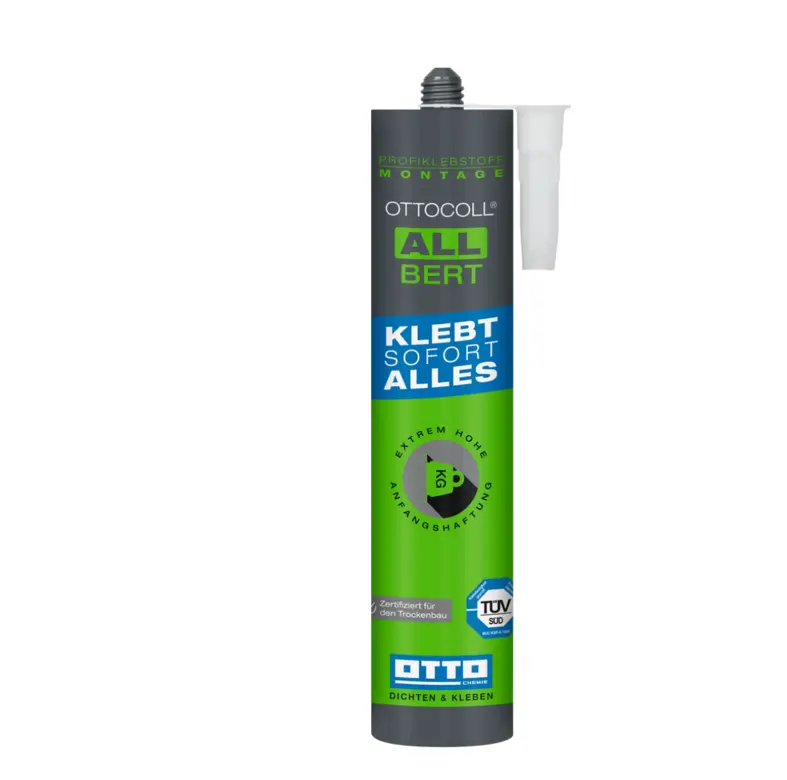
OTTOCOLL ALLBERT: Universal adhesive with extremely high initial tack
OTTOCOLL ALLBERT is a 1-component hybrid polymer adhesive based on STP for indoor and outdoor use. The initial tack is around 200 kg/m² – high enough that bonded components generally remain in place without additional fixation. This eliminates the work step that usually takes the most time when gluing vertical surfaces: supporting, wedging, waiting. The adhesive cures elastically, compensates for movement between components, and is silicone-free and isocyanate-free.
Certified for screwless installation of UW profiles
For drywall construction, TÜV SÜD certification is available for screwless mounting of UW profiles, including the associated bonding strengths. VHT GmbH has tested the suitability for bonding drywall profiles according to DIN 18183-1 and DIN 4103-1. In addition, an airborne sound insulation test according to DIN EN ISO 10140-2:2021-09 by PfB Prüfzentrum für Bauelemente shows increased sound insulation compared to conventional construction methods. Bonded connecting profiles also mean: no drill holes in screed, tile backsplashes, or prefabricated ceilings – relevant wherever waterproofing layers or underfloor heating systems must not be damaged.
Substrates: from tiles and natural stone to plasterboard
The adhesive adheres to wood and wood-based materials, metal and metal coatings, coated glass and mirrors, plastics with the exception of PE and PP, concrete and cementitious materials, tiles and ceramics, brick and clinker, natural stone, rigid foam boards made of EPS and XPS, gypsum fiber and plasterboard panels, as well as glass without UV exposure. Moist substrates are not an exclusion criterion either. Typical applications, in addition to stud frames, include the bonding of wall cladding and decorative panels in sanitary, kitchen, and catering areas as well as in cold rooms.
Processing: substrate preparation is decisive
The bonding surfaces must be clean, free of dust and grease, and load-bearing. Release agents, preservatives, oil, water, and residues of old adhesives or sealants must be removed beforehand. Non-porous substrates are cleaned with a suitable cleaner and a lint-free cloth; porous substrates are mechanically cleared of loose particles, for example with a wire brush or grinding disc. The application temperature is between +5 °C and +40 °C. When bonding steam-tight materials over a large area, the applied adhesive is moistened with a little water from a spray bottle so that curing does not stall. When joining, firm pressing ensures full-surface bonding; air pockets in the adhesive joint must be avoided.
Curing and mechanical properties
The skin formation time at 23 °C and 50 % relative humidity is approximately 10 minutes, and full curing in 24 hours is about 3 mm. Shore A hardness is around 60, tensile strength is approx. 2.7 N/mm², and elongation at break is about 150 %. The cured adhesive is temperature resistant from −40 °C to +100 °C, short-term over 90 minutes up to +150 °C. For the dimensioning of the adhesive surface in non-load-bearing bonds, a maximum permissible stress of 0.01 N/mm² applies.
Bonding mirrors: stripe application instead of dots
When bonding mirrors and painted glass, the adhesive is never applied in dots, but in vertical stripes of no more than 200 mm in length. At least three stripes per square meter of glass must be provided, the width of which after pressing does not exceed 10 mm and the distance between them is at least 200 mm – this is the only way to maintain the air circulation necessary for curing. The adhesive layer thickness should be 2 to 4 mm, the minimum distance between mirror and substrate 1.6 mm, practically achieved via glued-on spacers. At least 100 cm² of bonding area is required per kilogram of glass weight. Full strength values are achieved after 48 hours at the earliest. Only mirrors whose reflective and protective layers comply with DIN EN 1036 may be bonded.
Low-emission and tested for areas close to food
The adhesive is classified as very low-emission according to EMICODE EC 1 Plus and is low-odor during processing; after curing, it is odorless. A declaration of no objection from ISEGA certifies suitability for use in areas close to food – a point regularly requested in catering, kitchen, and cold room construction. Fire behavior is classified in Class E according to EN 13501. The SHI product passport from the Sentinel Holding Institute provides the classification for DGNB, QNG, BNB, BREEAM, and the EU Taxonomy.
Overpaintability, storage, and preliminary tests
The cured adhesive can be painted and varnished over; recoating with coating materials is possible after about one hour, depending on climate and coating type. Compatibility between coating and adhesive must be checked in advance, as oxidatively drying paints such as alkyd resin varnishes can delay or prevent drying, and purely mineral paints are not suitable for full-surface painting due to their brittleness. Store in a dry place below 60 % relative humidity and at temperatures between +15 °C and +25 °C; shelf life is 12 months from manufacture. Prolonged storage above 30 °C can reduce initial tack. A test application is recommended before each use.
White color for visible adhesive joints
The white version is suitable wherever the adhesive remains visible after installation or adjoins light-colored components – for example on white decorative and wall cladding panels, light skirtings, or cable ducts. Colors can be affected by high temperatures, chemicals, vapors, or UV radiation; this has no effect on product properties. The adhesive is also available in gray and black.
Technical data at a glance
- Article number: 13206
- Product type: 1K hybrid polymer adhesive (STP)
- Container: 290 ml cartridge
- Color: white
- Initial tack at 23 °C: approx. 200 kg/m²
- Skin formation time at 23 °C / 50 % RH: approx. 10 minutes
- Curing in 24 hours at 23 °C / 50 % RH: approx. 3 mm
- Processing temperature: +5 °C to +40 °C
- Temperature resistance: −40 °C to +100 °C, short-term up to +150 °C
- Shore A hardness according to ISO 868: approx. 60
- Tensile strength according to ISO 37, Type 3: approx. 2.7 N/mm²
- Elongation at break according to ISO 37, Type 3: approx. 150 %
- Stress value at 100 % elongation: approx. 2.4 N/mm²
- Density at 23 °C according to ISO 1183-1: approx. 1.5 g/cm³
- Viscosity: pasty, non-sag
- Fire behavior according to EN 13501: Class E
- Emissions: EMICODE EC 1 Plus
- Shelf life: 12 months from manufacture
- Free from: silicone, isocyanates
Is fixation required after bonding?
Generally no – the initial tack of around 200 kg/m² holds bonded components without tools.
The actual initial tack varies significantly depending on the material and method of application. For heavy mirrors, temporary fixation with blocks, wedges, or removable adhesive tapes may be useful. Full strength values are achieved after 48 hours at the earliest.
May the adhesive be used for screwless drywall installation?
Yes, TÜV SÜD certification is available for the screwless installation of UW profiles.
In addition, VHT GmbH has tested suitability for bonding drywall profiles according to DIN 18183-1 and DIN 4103-1. An airborne sound insulation test according to DIN EN ISO 10140-2:2021-09 demonstrates increased sound insulation compared to conventional construction methods.
Which substrates does OTTOCOLL ALLBERT not adhere to?
The adhesive is not suitable on PE and PP plastics.
For glass, suitability applies only without UV exposure. The adhesive is also not intended for copper under the influence of UV or temperature. For mineral substrates and untreated wood in mirror construction, a primer is mandatory, among other things to seal off alkalinity.
Does bonding also work on moist substrates?
Yes, the adhesive also adheres to damp substrates.
The bonding surfaces must nevertheless be clean, free of dust and grease, and load-bearing. When bonding steam-tight substrates over a large area, moistening the applied adhesive with a little water is even recommended, as moisture accelerates curing.
How is the adhesive applied when bonding mirrors?
In vertical stripes max. 200 mm long, never in dots.
At least three stripes are required per square meter, stripe width after pressing max. 10 mm, distance between them at least 200 mm. The adhesive layer thickness should be 2 to 4 mm, the minimum distance to the substrate 1.6 mm. At least 100 cm² of bonding area must be provided per kilogram of glass weight.
Can the cured adhesive be overpainted?
Recoating with coating materials is possible after about one hour, depending on climate and coating type.
Compatibility must be checked in advance. Oxidatively drying coatings such as alkyd resin varnishes can delay or prevent drying and curing. Purely mineral paints are not suitable for full-surface overpainting due to their brittleness.
How long and how can the adhesive be stored?
Shelf life is 12 months from manufacture.
Storage in unopened original containers in a dry place below 60 % relative humidity and between +15 °C and +25 °C is recommended. Prolonged storage above 30 °C can reduce initial tack. The specific expiration date is stated on the container.
Do you have any questions on this item?