


New

EUR
5,49 Excl. VAT
*
EUR
6,53 VAT included
*
RRP: € 8,95
In Stock


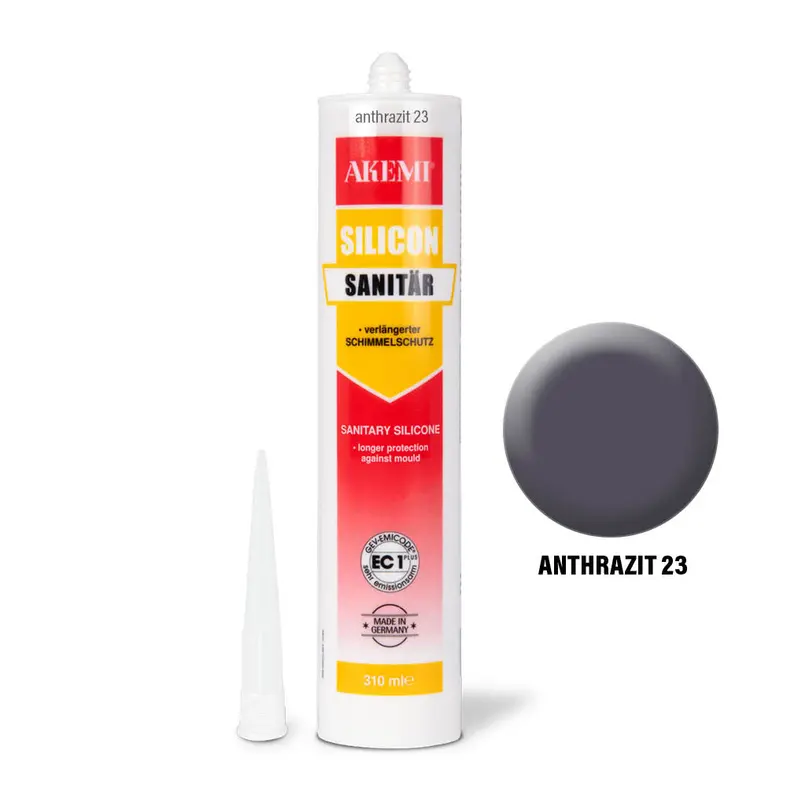
The smell of vinegar when the cartridge opens is not a side effect — it is the reaction principle. AKEMI® Sanitary Silicone is acetate cross-linked and releases acetic acid during hardening. For the tiler that means there is a list of materials this joint must not go near.
Anthracite 23 is the darkest grey in the range and therefore often ends up where dark tiles meet exposed fittings and pipework. Exactly the constellation in which that list matters.
AKEMI® Sanitary Silicone is a special joint-sealing material for expansion and connecting joints in kitchens, living and sanitary areas on ceramic tiles. Approved for interior and exterior use. Excellent and durable adhesion on non-porous silicate materials: glass, glazed ceramics, tiles, clinker, glass ceramics, email, porcelain and aluminium.
The principle. The product is acetate cross-linked and releases acetic acid during hardening. Use on or near acid- or corrosion-sensitive materials is not recommended. The manufacturer names specifically: iron, copper, brass, zinc, lead, concrete and building materials containing lime or cement.
Non-ferrous metals. Discolouration may occur in contact with non-ferrous metals such as copper or brass. In practice this covers exposed fittings, escutcheons, waste sets and visible copper pipework — anything in a bathroom sitting close to the joint.
Elastomers and coatings. Discolouration occurs on tar or bitumen coated surfaces as well as on elastomers such as EPDM, APTC or neoprene. Sufficient adhesion cannot be achieved on these materials either — nor on polyolefins (PE, PP), silicone, PTFE and butyl rubber.
Adjacent materials and functional units. The manufacturer goes further than the adhesion face: durable compatibility between the sealant and adjacent materials — coating systems, for instance — or complete functional units such as insulating, laminated or laminated safety glazing must be ensured before use, in order to avoid discolouration, loss of adhesion, migration effects or other harmful consequences.
And what does work: tiles, glazed ceramics, glass, clinker, glass ceramics, email, porcelain and aluminium — excellent and durable adhesion. On metal generally, the data sheet allows no general prediction; a test of adhesion and compatibility must be carried out beforehand.
| Colour | anthracite 23 (AKEMI item number 40023) |
| Container | 1C-cartridge, 310 ml |
| System | acetate cross-linked |
| Permissible total deformation | 20 % |
| Working temperature | +5 °C to +35 °C |
| Temperature resistance | -50 °C to +180 °C |
| Skin formation time (23 °C, 50 % RH) | approx. 15 minutes |
| Hardening (23 °C, 50 % RH) | approx. 2 mm per 24 hours |
| Shore A hardness / modulus | ~22 / 0.44 N/mm² |
| Storage | 5–25 °C, unopened at least 24 months |
Full characteristic values, test standards and processing instructions: see the manufacturer's Technical Data Sheet.
| Joint width x depth | Metres per cartridge |
|---|---|
| 5 x 5 mm | 12 |
| 10 x 10 mm | 3 |
| 15 x 10 mm | 2 |
| 20 x 15 mm | 1 |
Full instructions for use in the manufacturer's Technical Data Sheet.
For professional use only. Not suited for porous, absorbent surfaces like natural and artificial stone — danger of discolouring in the marginal zone. AKEMI offers dedicated neutral cross-linked products for natural stone.
EN 15651-3 (XS1) · EN 15651-4 (PW20LM Ext.-Int.) · GEV EMICODE® EC1PLUS · VOC France emission class A+ · REACH compliant (EU No. 1907/2006) · IVD-leaflets 3-1 and 14.
Sanitary Silicone Akemi transparent 01 (Art. No. 16255) · Sanitary Silicone Akemi white 02 (Art. No. 16256) · Sanitary Silicone Akemi silver grey 05 (Art. No. 16259) · Sanitary Silicone Akemi pale grey 11 (Art. No. 16264) · Sanitary Silicone Akemi bright grey 12 (Art. No. 16265) · Sanitary Silicone Akemi flannel grey 15 (Art. No. 16268) · Sanitary Silicone Akemi stone grey 17 (Art. No. 16270) · Sanitary Silicone Akemi sanitary grey 18 (Art. No. 16271) · Sanitary Silicone Akemi grey 22 (Art. No. 16275) · Sanitary Silicone Akemi cloud grey 74 (Art. No. 16300) · Sanitary Silicone Akemi fog 82 (Art. No. 16304)
That is the reaction principle, not a defect. After hardening the sealant is odourless and physiologically harmless. During hardening, however, the acetic acid is the reason behind every material restriction the product carries.
Use on or near acid- or corrosion-sensitive materials such as iron, copper, brass, zinc and lead is not recommended. This covers not only the adhesion face itself but the immediate vicinity — the acetic acid acts through the surrounding air during hardening.
On surfaces such as wood, metal, paints, glazes, plastics, melamine or epoxy resin, powder coatings, anodising, stainless steel or sanitary acrylate the manufacturer offers no general statement on adhesion and compatibility. A test must be carried out on these and all other unknown surfaces before use. The explicit "not recommended" list — iron, copper, brass, zinc, lead — does not name stainless steel.
The manufacturer words this as a statement, not a possibility. On top of that: on materials with generally adhesion-repellent properties — the manufacturer counts polyolefins, silicone, PTFE, butyl rubber and tar-, bitumen- or wax-containing materials alongside EPDM and neoprene — sufficient adhesion cannot be achieved.


